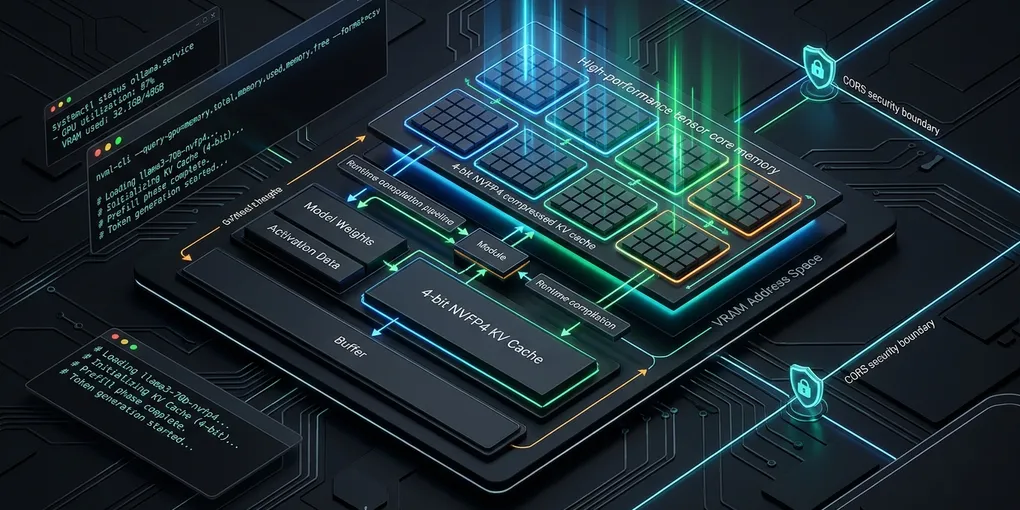
vLLM v0.32 Migration: Python, CORS, Parsers, and KV Cache Limits
Correction, November 12, 2026: The previous article offered a broad Ubuntu system upgrade, a third-party Python PPA, a systemd service template with unverified model and cache options, and a shortcut that suggested wildcard CORS origins. It also claimed a particular 4-bit KV-cache mode always halves memory and described an unmeasured 45-second kernel-compile penalty. This revision preserves the original v0.32 migration topic but makes compatibility, network access and performance conditional.
The official vLLM v0.32.0 release notes document changes including dropping Python 3.10 support, restricting default CORS origins, adding Hugging Face template-based tool and reasoning parsers, changes to KV-cache precision support, and a download-kernels command.
These are release-specific engineering changes. They do not authorize an automated upgrade of every Ubuntu host, guarantee memory savings for every model, or prove an existing reverse proxy is correctly authenticated.
1. Assess the actual installed environment
Before changing an inference service, collect non-destructive version information:
python3 --version
python3 -m pip show vllm
nvidia-smi --query-gpu=index,name,driver_version,memory.used,memory.total --format=csv
The second command requires the environment where vLLM is installed. If you are connected to a host running an unrelated Python version, those results are not necessarily the service’s actual runtime.
The v0.32 release notes state that Python 3.10 support was dropped, with Python 3.11 or later required. That is a package/runtime compatibility requirement. It does not mean the operating system’s interpreter or /usr/bin/python3 should be replaced.
Use a separately provisioned, version-pinned runtime or tested container through the organization’s approved build and deployment process. Avoid adding an external Python package archive to a production host simply because a blog post names it. Confirm supported Python, PyTorch, CUDA/ROCm and driver combinations before installing or upgrading.
2. Restrictive CORS is not application authentication
The vLLM 0.32.0 release notes state that default CORS origins are now restricted and identify --allowed-origins as a browser-origin configuration option. Verify the exact flag syntax in the matching installed CLI version.
When a browser client uses a different origin, its browser-enforced preflight may fail without the appropriate allowed origin. A fix is to identify the trusted browser application’s exact origin and permit only that origin where required.
For example, a security review should explicitly document the intended application origin:
Approved browser origin example: https://chat.example.internal
Do not treat the wildcard origin as a repair for production access control.
CORS is not a user-authentication or firewall boundary. Non-browser clients may be able to call an HTTP API even when browser cross-origin requests are restricted. An externally reachable model endpoint still requires appropriate network isolation, authentication, credentials and authorization. For broader access-control context, see the current vLLM developer-preview security guidance; do not assume every setting described there applies unchanged to v0.32.0.
Avoid a wildcard --allowed-origins setting merely to make a development browser connect. If a reverse proxy is involved, determine where CORS headers and access control are implemented so duplicated or conflicting configuration does not accidentally widen access.
3. Template-based tool and reasoning parsers
The v0.32 release introduced generic Hugging Face template parsers, documented in the upstream release notes, with flags --tool-call-parser hf and --reasoning-parser hf.
Their successful use depends on the selected model’s shipped tokenizer or response template and on the exact versioned frontend. These are not universal replacements for every custom parser or for all models that include a textual “think” section.
A practical test compares model outputs on the same small tool-call and reasoning input, checking the response fields your application actually consumes. Confirm both the schema and any reasoning redaction policy before releasing agent tool use to a public client.
Do not assume that the mere presence of the generic parser makes model-generated tool commands safe, correctly authorized or compatible with your application schema. Model tool use should remain behind explicit service-side tool permissions.
4. NVFP4 KV-cache support: capability is not a fixed savings claim
The v0.32 release notes describe expanded NVFP4 low-precision KV-cache support on specified NVIDIA architectures and decoding paths. Supported combinations vary by GPU, backend, attention kernel and model implementation.
A 4-bit data representation stores fewer raw bits per value than FP8 or FP16. However, a dtype name does not establish a measured total VRAM saving or guaranteed speedup for a complete model-serving configuration. Use the target GPU and supported backend to measure actual allocations and output quality rather than assuming a fixed percentage.
Before attempting a lower-precision cache, check:
- Your GPU compute capability and the v0.32 supported attention path.
- The selected model’s actual KV layout, tensor and pipeline settings.
- Whether the versioned CLI accepts the chosen cache dtype and kernel.
- Output-quality acceptance tests, long-context behavior and memory metrics.
- A fallback configuration that uses the previously supported cache format.
Do not publish a hard-coded --kv-cache-dtype fp4 or --gpu-memory-utilization 0.92 as a guaranteed migration recipe for an arbitrary 32B model and GPU. The feature’s release-note availability does not prove that any one checkpoint can use it safely.
The old article’s precise “half the KV memory”, “45 seconds saved” and exact first-request timing claims were not supported by controlled same-hardware measurements, so they have been removed.
5. Precompiled kernels and controlled rollout
The vLLM v0.32 CLI guide documents commands including download-kernels. Some supported deployments can prepare compatible FlashInfer kernels before normal serving to reduce runtime compilation.
The operation’s benefits depend on the installed version, kernel architecture, configuration and local cache. It is not a fixed guarantee that all first-token or initial request latency disappears.
Do not install the release directly into a running production interpreter just to test this feature. Build and validate an alternate environment, compare the exact active model’s behavior, and keep a rollback image or lock file.
A staged migration should include:
- Pin the old and proposed vLLM versions, Python interpreter, accelerator runtime, kernel and model configuration.
- Compare CORS behavior with both an approved browser origin and an unauthenticated browser request; independently test API authentication.
- Verify tool-parser outputs and any protected tool execution.
- Test the selected KV-cache dtype on the target GPU, recording outputs and actual allocation.
- Observe readiness, request errors, memory use and rollback behavior during a safe deployment window.
- Preserve previous stable configuration and verify service logs rather than restarting the host or modifying a systemd unit from an untested template.
6. What has not been tested here
This article interprets the v0.32.0 official release notes and versioned CLI documentation, not a production migration performed on your GPU. No Linux kernel module, system Python, NVIDIA driver, package index, model host, CORS configuration or Cloudflare deployment was changed to test these instructions.
A version update is complete only after the operator confirms the environment-specific acceptance criteria. The article does not assert a particular cold-start time, token throughput, exact KV-cache savings or universal success for an API service.
Primary references
- vLLM upstream v0.32.0 release notes and breaking changes
- vLLM v0.32.0 command-line guide
- vLLM v0.32.0 serve parameters
- vLLM: serving security and access boundaries
Editorial correction, November 12, 2026: Original URL, publication date and hero image remain unchanged. The guidance now distinguishes documented features from hardware- and application-dependent compatibility.